


Agenda

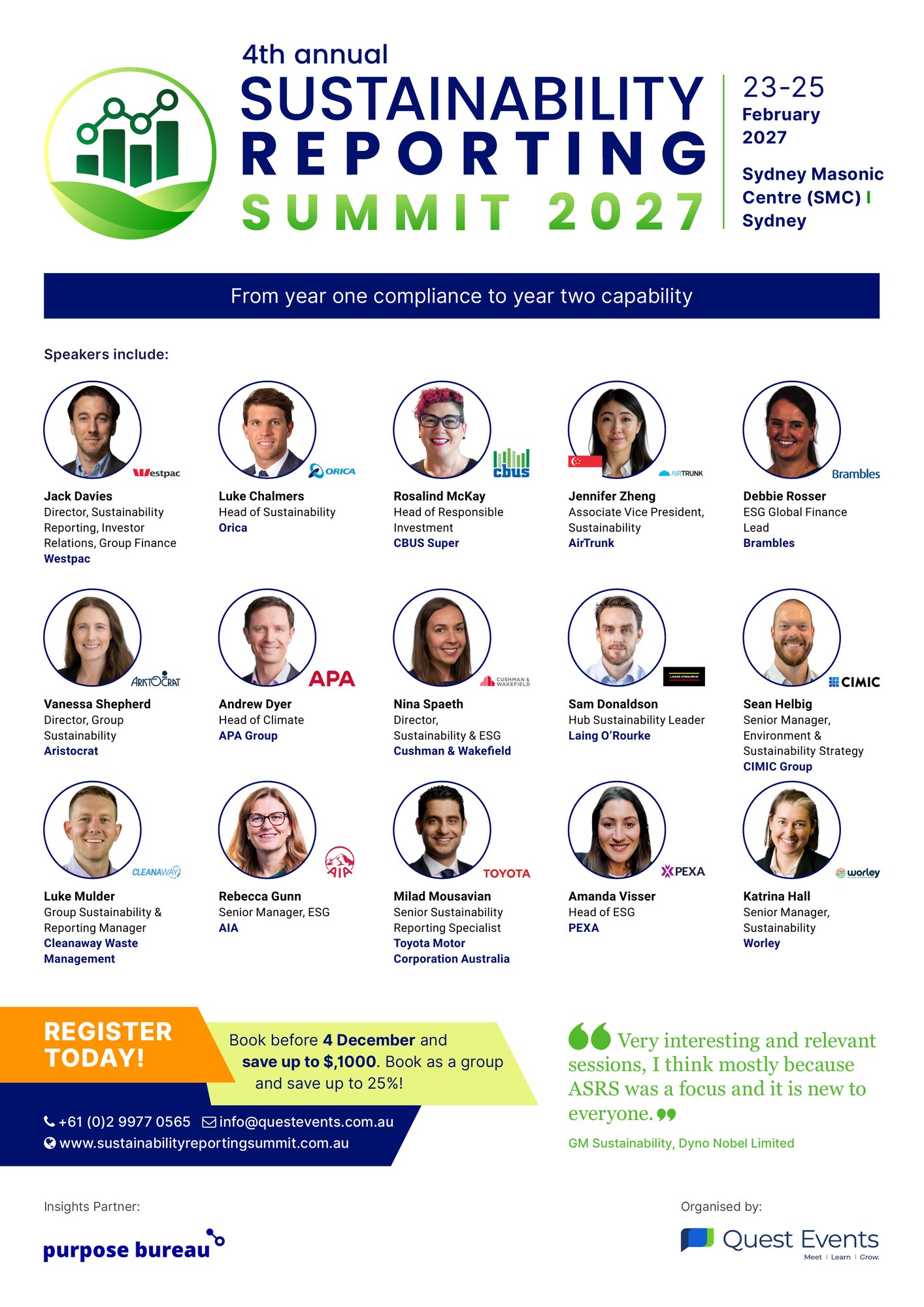
Download the brochure for more information on the full agenda and speaker line-up
Event Schedule
- 23 February - Pre-conference Masterclass
- 24 February - Conference Day One
- 25 February - Conference Day Two

- Day/Stream
- 23 February - Pre-conference Masterclass
- 24 February - Conference Day One
- 25 February - Conference Day Two

- Session Type
- Break
- Panel Discussion
- Fireside Chat
- Masterclass
- Case study
- Roundtable Discussions

- Time
- Morning
- Afternoon
Registration & welcome coffee
Opening remarks from the Chair
Embedding reporting into governance, accountability & business decisions
From compliance to business resilience: embedding reporting into enterprise decision making

Orica
From compliance to business resilience: embedding reporting into enterprise decision making
- Examine the shift from an ambition-led specialist function to a whole-of-company obligation, and the impact on board posture, accountability and ownership
- Understand how organisations are redesigning teams, skills and accountability across sustainability, finance, risk and investor relations for repeatable reporting
- Explore how reporting connects climate risk, resilience and value creation to support board, investor and internal decisions
Orica
Panel discussion: Who owns the report when sustainability becomes a finance, risk and governance issue?

CIMIC Group

Worley

Westpac

IXOM
Panel discussion: Who owns the report when sustainability becomes a finance, risk and governance issue?
- How is mandatory disclosure reshaping board oversight and ownership?
- Why is responsibility shifting beyond sustainability teams?
- How are businesses assigning ASRS accountability?
- How can compliance support strategy and value creation?
CIMIC Group
Worley
Westpac
IXOM
Directors' legal obligations under mandatory climate reporting

Aristocrat
Directors' legal obligations under mandatory climate reporting
- Understand directors' personal and organisational legal exposure under mandatory climate reporting
- Learn how liability and due diligence expectations differ from traditional financial reporting
- Strengthen board-level assurance and reduce legal risk
Aristocrat
Morning Tea
Choosing defensible scenarios to secure accurate data & drive decisions
Picking the right scenarios: Physical and transition climate risk

CS Energy
Picking the right scenarios: Physical and transition climate risk
- Select scenarios that are decision-useful rather than simply compliant
- Distinguish between physical and transition risk scenarios and when each applies
- Apply a practical framework for justifying scenario choices to auditors and boards
CS Energy
Panel discussion: Making scenario analysis assurance-ready

Cushman & Wakefield

Pallion

Powerco

Frasers Property
Panel discussion: Making scenario analysis assurance-ready
- Hear candid reflections on mistakes and misjudgements from first-round scenario analysis
- Understand where physical risk assessments fall short of assurance expectations
- Avoid common scenario analysis missteps in year two
Cushman & Wakefield
Pallion
Powerco
Frasers Property
Scope 3
From Estimate to Evidence: How data and AI are rewriting the Scope 3 playbook for the reasonable assurance era

Founder & CEO
Purpose Bureau
From Estimate to Evidence: How data and AI are rewriting the Scope 3 playbook for the reasonable assurance era
Year two of ASRS means disclosing Scope 3 under limited assurance, with reasonable assurance coming. Drawing on more than 1,000 ASRS reports, this session shows you which categories are material in your sector, which data mixes hold up under assurance, and where direct measurement is worth your investment. You’ll leave with a clear plan to get from limited to reasonable assurance.
Founder & CEO
Purpose Bureau
Networking Lunch
Scope 3 and value chain: building partnerships across the chain

Burra Foods
Scope 3 and value chain: building partnerships across the chain
- Engage suppliers through data-sharing partnerships, joint roadmaps and shared investment in abatement
- Explore how industry collaboration and shared reporting and MRV infrastructure can address leverage across the value chain
- Understand how joint decarbonisation initiatives improve Scope 3 data quality and availability
Burra Foods
Balancing internal capability, third-party costs & future reporting needs
From bespoke to business-as-usual

Toyota Motor Corporation Australia
From bespoke to business-as-usual
- Turn one-off consultant-led modelling into a repeatable, business-as-usual process
- Understand the systems, skills and governance needed to embed reporting capability internally
- Reduce reliance on bespoke consultant engagements each cycle
Toyota Motor Corporation Australia
Fireside chat: What to keep in-house vs. what to outsource

Energy Queensland

Vocus
Fireside chat: What to keep in-house vs. what to outsource
- Understand the trade-offs between internal modelling capability and consultant reliance
- How peer organisations have decided what to keep in-house versus outsource
- Gain a practical framework for building a long-term capability roadmap
Energy Queensland
Vocus
From climate-only to full sustainability disclosure

AirTrunk
From climate-only to full sustainability disclosure
- Understand how the reporting landscape is expanding beyond climate into nature, social and other sustainability domains
- Learn what TNFD and TSIFD require, and how they intersect with your existing AASB S2 disclosure
- Prepare your organisation for the next wave of standards before they become mandatory
AirTrunk
Afternoon Tea & Networking
Roundtable Discussions
Roundtable 1: Integrating climate risk into existing risk frameworks
Roundtable 2: Managing reporting across AASB S2, XRB and international regimes
Roundtable 3: Aligning climate disclosure with AER and other regulatory requirements
Roundtable 4: Judging materiality: documenting your CRRO decisions
Roundtable 5: AI in sustainability reporting: where automation helps and human judgement matters
Roundtable 6: Reporting without a sustainability team: what finance and risk teams need to own
Roundtable 7: What investors want to see in your report
Closing remarks from the Chair & end of Day 1
Networking Drinks
Registration & welcome coffee
Opening remarks from the Chair
Quantifying financial impacts & strengthening controls
Linking climate scenarios to CAPEX, OPEX, cashflow and asset value

CBRE
Linking climate scenarios to CAPEX, OPEX, cashflow and asset value
- Translate scenario outputs into tangible CAPEX, OPEX and cashflow impacts
- Understand how leading organisations are linking climate risk to asset value and investment decisions
- Apply practical modelling approaches to connect scenario analysis with financial reporting
CBRE
What auditors, boards and investors expect from climate quantification in year two

Alinta Energy
What auditors, boards and investors expect from climate quantification in year two
- Understand credible quantification of anticipated financial effects under AASB S2 and what auditors, boards and investors expect
- Common weaknesses in year-one reports and the areas auditors challenge most
- Build the evidence and support needed to defend your numbers
Alinta Energy
Case study: Building an assurance-ready sustainability data environment

Ventia
Case study: Building an assurance-ready sustainability data environment
- Integrate sustainability requirements into core business planning, operations and reporting processes
- Establish robust governance, systems and data processes that support credible reporting and assurance
- Turn sustainability data into practical decisions across risk, resource use and operations
Ventia
Morning Tea
Making assurance-ready judgements and managing auditor expectations
Case study: Making materiality judgements assurance-ready in your second ASRS report

Laing O’Rourke
Case study: Making materiality judgements assurance-ready in your second ASRS report
- Learn how to document materiality decisions that can withstand auditor, board and regulator scrutiny
- How to evidence the assumptions, thresholds and judgements behind what is included, excluded or deprioritised
- Build an assurance-ready evidence trail that links materiality, methodology, data quality and disclosure outcomes
Laing O’Rourke
What "reasonable, useful, pragmatic, proportionate" means in practice

Centuria Capital Group
What "reasonable, useful, pragmatic, proportionate" means in practice
- Understand how proportionality provisions apply in practice
- Hear how organisations interpreted “reasonable, useful, pragmatic, proportionate” in year one
- Build a rationale for proportionality judgements your auditor and board can sign off on
Centuria Capital Group
The auditor and preparer relationship

AIA
The auditor and preparer relationship
- Hear candid reflections from both sides on the year-one audit experience
- Understand how the preparer-auditor relationship will evolve as assurance requirements increase
- Gain practical tips for a more productive assurance relationship in year two
AIA
Networking Lunch
Panel discussion: Who should you listen to? Navigating conflicting advice on sustainability disclosures

Cleanaway Waste Management

Growthpoint Properties Australia

Koppers Carbon Materials & Chemicals
Panel discussion: Who should you listen to? Navigating conflicting advice on sustainability disclosures
- Clarify the distinct roles of legal advisers, climate consultants, assurers and other specialists, including which questions each is best placed to answer
- Understand why different advisers can reach different conclusions on the same analysis or disclosure, and distinguish genuine disagreement from advice addressing different risks
- Learn how to resolve conflicting interpretations, document key decisions and reach a disclosure position that management and directors can confidently approve
Cleanaway Waste Management
Growthpoint Properties Australia
Koppers Carbon Materials & Chemicals
Building investor trust through climate disclosure
Fireside chat: How climate disclosures influence investment decisions, engagement and capital allocation

CBUS Super

Australian Council of Superannuation Investors
Fireside chat: How climate disclosures influence investment decisions, engagement and capital allocation
- Understand how investors analyse climate disclosures, and which signals they trust and which they discount
- Learn what influences investment decisions and capital allocation, and how disclosures shape stewardship and engagement priorities
- See what happens after an investor reads your report: the questions, engagement and decisions that follow
CBUS Super
Australian Council of Superannuation Investors
Panel discussion: What investors need from climate disclosures

APA Group

PEXA
Panel discussion: What investors need from climate disclosures
- Learn how clarity, structure and comparability make climate disclosures easier for investors to use
- Focus disclosure on what is material, and present risks, assumptions and metrics credibly without burying the insight or overstating the story
- Leave with practical steps to communicate more effectively and make your climate disclosures more useful to investors
APA Group
PEXA
Afternoon Tea & Networking
Turn disclosure into decisions
From assessment to implementation: embedding climate risk into existing business processes

Sunwater
From assessment to implementation: embedding climate risk into existing business processes
- Move from identifying and reporting climate risks to embedding them into the business processes that already guide decisions
- Understand how to integrate climate risk into established frameworks for risk, strategy, finance, capital planning, procurement and operations
- Apply practical lessons on governance, ownership and cadence so climate risk becomes part of business-as-usual rather than a standalone reporting exercise
Sunwater
Panel discussion: How reporting changes executive decisions

CDC

The Perth Mint

OceanaGold
Panel discussion: How reporting changes executive decisions
- Explore how sustainability reporting has changed the questions executives ask, the trade-offs they consider and the decisions they are prepared to make
- Understand where reporting has influenced board and executive decisions on strategy, risk appetite, investment, capital allocation and organisational priorities
- Move beyond disclosure as an output and examine how climate reporting can become a practical input into executive decision-making
CDC
The Perth Mint
OceanaGold
Closing remarks from the Chair & end of the Summit
Masterclass A: Advanced Sustainability Reporting - Beyond Compliance

BDO

Partner, Advisory, Sustainability and Corporate Reporting
BDO
Masterclass A: Advanced Sustainability Reporting - Beyond Compliance
This one-day intensive masterclass is designed for senior practitioners with a strong grounding in sustainability reporting who need to move beyond minimum compliance and build defensible, decision-useful capability.
Participants will gain practical skills to strengthen governance, data, controls, quantification, scenario analysis, Scope 3 and assurance readiness, while using reporting to support business planning, risk management and capital allocation.
Learning outcomes
- Keep up to date with mandatory sustainability reporting developments in Australia and globally
- Apply good practice across AASB S2 governance, strategy, risk management, metrics and targets
- Conduct climate risk and opportunity assessments that generate decision-useful business insights
- Use scenario analysis to support strategic planning and defensible disclosure
- Develop proportionate approaches to financial quantification that meet stakeholder expectations
- Strengthen governance, oversight and accountability for sustainability reporting
- Improve the quality, consistency and reliability of sustainability and climate data
- Build effective controls, reporting processes and assurance-ready evidence trails
- Navigate Scope 3 measurement, estimation and value-chain engagement challenges
- Use sustainability reporting to support planning, capital allocation and risk management
Participants will leave with advanced, practical skills to improve reporting quality, strengthen data and governance foundations, meet assurance expectations and position sustainability reporting as a valuable input to business decisions.
BDO
Partner, Advisory, Sustainability and Corporate Reporting
BDO
Masterclass B: From Data to Decisions - Climate Risk Scenario Analysis

CSIRO
Masterclass B: From Data to Decisions - Climate Risk Scenario Analysis
This one-day intensive masterclass is designed for practitioners working with climate risk, disclosure and assurance who need to turn climate and operational data into credible, decision-ready scenarios.
Participants will gain practical skills to select and justify physical, transition and emissions scenarios, manage competing adviser expectations, and connect scenario outputs to reporting judgements, resilience planning and business decisions.
Learning outcomes
- Identify and collect the climate and operational data needed for credible, disclosure-ready assessments
- Surface, test and document the assumptions that shape climate risk assessments and scenario choices
- Select defensible physical, transition and emissions scenarios and clearly explain why they were chosen
- Reconcile the competing expectations of lawyers, assurers and consultants
- Translate scenario outputs into reporting judgements and business decisions under uncertainty
- Evaluate the tools and methodologies used across physical, transition and emissions risk
- Apply scenario frameworks to improve decision-making and disclosure
- Avoid common climate risk and scenario-analysis pitfalls
Participants will leave with practical, hands-on skills to build defensible scenarios, improve disclosure quality and use climate risk analysis to support reporting, resilience planning and strategic decision-making.
CSIRO
- Day/Stream
- 23 February - Pre-conference Masterclass
- 24 February - Conference Day One
- 25 February - Conference Day Two
- 23 February - Pre-conference Masterclass
- 24 February - Conference Day One
- 25 February - Conference Day Two
Download the brochure for more information on the full agenda and speaker line-up