
Lessons from a Sustainability Reporting Trailblazer
There’s a wealth of sustainability reporting advice online from industry experts, consultants, and the government. But how many of these experts have actually gone through the process themselves? There is nothing so valuable as asking someone who has recently undertaken a reporting cycle to share their tips, tricks, successes and failures.
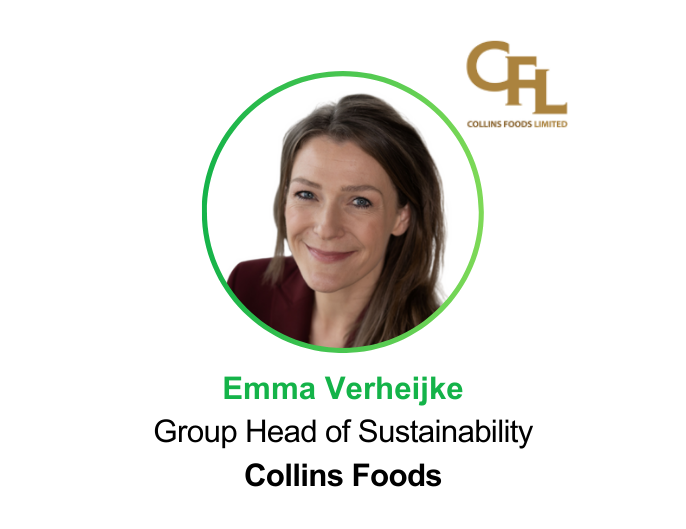
We interviewed Emma Verheijke, Group Head of Sustainability at Collins Foods Limited, a publicly-listed Australian company that operates more than 400 restaurants, including KFC and Taco Bell restaurants.
Which challenge from your first reporting cycle cost you the most time or resources, and how did you resolve it?
Collins Foods is currently progressing through its first reporting cycle as a Group 1 reporter, with its financial year ending in April 2026. One of the most time-intensive aspects of this year’s work has been the assessment of climate-related risks and opportunities (CRROs).
“While Collins Foods has been reporting on our impact on people and the planet for several years, our approach to evaluating the financial implications, specifically risks and opportunities, has been less developed,” says Verheijke.
Given its global footprint of more than 400 restaurants, the company recognised the importance of conducting a thorough physical risk assessment at the individual restaurant level, including an evaluation of supply chain vulnerabilities.
“A risk with these CRRO assessments (in my experience) is getting lost in the details,” she continues. There are a lot of parameters to consider across weather event return periods, time-horizons, climate scenarios, and quantifications of annualised average losses. We have taken the approach that our CRRO assessment should primarily serve as a strategic tool that informs our decision-making (mandatory reporting being a natural outcome of that process), and the level of detail needs to reflect that. This also led us to emphasise ensuring that all key stakeholders across the business have a clear understanding of the various components involved in assessing and reporting CRROs, including transparency around our chosen methodology, quantification proxies, potential mitigation strategies, and cost allocations.”
How did you determine the scope and materiality of your report?
“We use (double) materiality assessment to determine scope and focus of our reports, and link our sustainability topics materiality threshold to our broader Enterprise Risk Management risk appetite, which we discuss regularly with Management and our Board,” explains Verheijke. “We use our risk management scoring methodology, including looking at likelihood and severity, which results in a prioritisation of topics based on materiality score. In determining our strategy for each topic, we also look at how much influence we can have in changing outcomes. In other words, we look at whether we have direct control, or do we need to influence outcomes through collaboration with others, such as in our franchisee network and with suppliers.”
How did you organise governance, roles, and accountability across functions to prepare the report?
Collins Foods’ board Audit & Risk Committee (ARC) assists the Board in overseeing the integrity of the Group’s financial and sustainability reporting and reporting processes, including its sustainability and climate risk management and strategy. At the executive level, there is a Management Audit, Risk & Compliance committee that monitors the sustainability reporting process and risks and opportunity management. Moreover, Collins Foods has a Sustainability Council which includes heads of departments and other key functional staff, responsible for business accountability and ownership of material topics and sustainability performance monitoring.
Various project teams and working groups are responsible for operational management and delivery across the business. One of those working groups specifically deals with AASB S2 disclosures, and includes representatives from Finance, Risk, Legal and Sustainability.
Which internal practices, controls, or routines had the biggest impact on improving data quality and audit-readiness?
“We’re in the process of developing a comprehensive ‘data book’ or reporting protocol that clearly defines all metrics used across our reporting,” says Verheijke. “This includes definitions, units of measurement, calculation methodologies, data sources and flows, reporting frequency, data ownership, and quality assurance processes.”
Verheijke notes that striving for 100% perfect data is unrealistic, especially when working with multiple data sources, many of which rely on external stakeholders such as suppliers and partners. “What we can do is systemize our framework and process as much as possible, and clearly document dependencies and data quality considerations,” she says. “This exercise so far has helped increase ownership and understanding across the business, streamline processes, and identify areas where we would like to focus further improvement actions.”
If you could suggest three practical actions for an organisation preparing to report for the first time, what would they be?
“First, just start! Start small (but focus on the biggest priorities first) and build out rather than trying to do everything at once. Reporting (and your sustainability strategy and everything that goes with it) is an iterative process. You need to allow time to trial and fail as crucial steps in the process.”
Secondly, keep it strategic. Focus on information that is useful for strategic decision-making, and let reporting be the natural outcome of that. Ultimately, reporting is a means to an end, and (especially in more cost-conscious business environment) you need to balance spend on reporting vs spend on actions. Aim for "enough precision to make the decision,” and support accountability.
Finally, do not jump the gun by purchasing a silver bullet software system. The sustainability reporting landscape is still very much in development, as are all associated metrics, targets, reporting requirements, data points. While it can be tempting to go for a software solution on the market that promises to solve all your reporting issues for you, I would recommend you do some work internally first in identifying what the right metrics and data points are, and what type of tool would best support your process.”